

There’s No Question People are Under Pressure Right Now.
Everywhere you look, consumers are scrutinizing money spent—on groceries, gas, everyday essentials, and yes, even on luxury purchases. The pressure is real, the trade‑offs are constant, and the mindset has shifted.
Yet one fundamental truth remains unchanged: brands that understand their customers better than their competitors continue to outperform.
What has changed is the context. Economic uncertainty has raised expectations, sharpened decision‑making, and pushed brands to rethink how value is delivered and communicated. That requires loyalty strategies to evolve.
When Discount Is the Baseline, What’s Left?
In deeply discounted categories, traditional loyalty mechanics don’t always translate. When price is already compressed, adding incremental dollars‑off quickly becomes unsustainable and highly visible to the business.
But that doesn’t diminish the importance of customer identification or relationship‑building. It simply means the value exchange needs to look different. The real opportunity lies in reframing what customers get in return for identifying themselves. Not more discount, but more relevance, more access, more recognition, and more intentional experiences. 4.3x lift on “I am loyal to the program” when members agree that they receive relevant offers from the program.
Source: Data from Bond Brand Loyalty Data Lake, originally published in The Loyalty Report, 2025 USA
We see this showing up through members‑only moments, exclusive drops, events, early access, curated content, and even experiential rewards. These elements reinforce value without undermining price architecture—and they create compelling reasons for customers to engage beyond the transaction.
Access and Know Me drivers are top 2 in importance in driving loyalty to the program, with Financial drivers coming in at 3rd overall in importance.
Source: Data from Bond Brand Loyalty Data Lake, originally published in The Loyalty Report, 2025 USA
Relevance Still Leads Engagement
One of the most nuanced shifts we’re seeing in Bond’s intelligence today is the relationship between relevance and privacy.
Consumers are increasingly conscious of how their data is used—largely driven by the broader AI conversation—and they’re asking brands to be more responsible stewards of their information. At the same time, when you examine what actually drives engagement and performance, relevance remains the strongest lever.
That distinction matters. Consumers aren’t rejecting relevance; they’re rejecting irrelevance. They don’t want to be flooded with messages that don’t reflect their needs or behaviors. If I’ve never purchased baby gear, sending me baby gear doesn’t feel personalized. It feels careless.
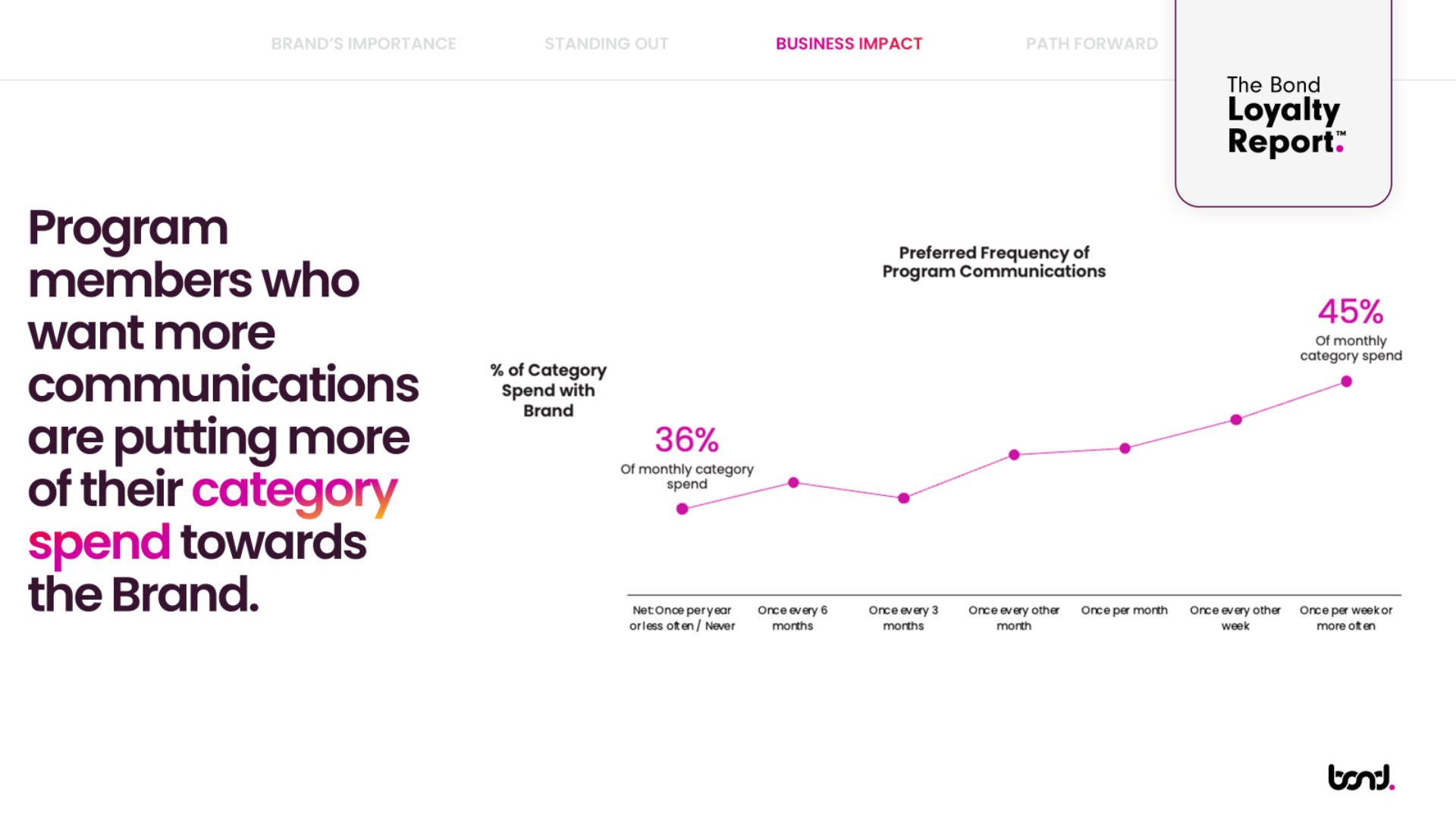
Curated, contextual relevance still strengthens trust and deepens relationships over time. In practice, the better aligned your communications are to a customer’s interests, the more open they are to hearing from you—and the more likely they are to concentrate spend with your brand.
Value Is Not a Customer Segment
Another important reality in today’s environment is that value is no longer confined to a single demographic. It spans the entire income spectrum.
86% of luxury shoppers are also shopping at Costco and Walmart.
[walletIQ data showing promiscuity in the value category]
Source: Data from Bond Brand Loyalty Data Lake, Bond’s WalletIQ, 2025 USA
- Customers who depend on value retailers as a necessity.
- Customers who shop value strategically despite higher spending power.
- High‑income households trading down in response to economic uncertainty.
- Loyal, frequent shoppers driven primarily by price.
- Infrequent shoppers who respond to relevance and discovery rather than routine.
Each of these cohorts behaves differently, but they all represent growth opportunities when value is paired with relevance.
For highly price‑sensitive customers, consistency and recognition matter. Even small signals that say “we know you and appreciate your relationship with us” can shift wallet share between competing value brands.
For higher‑income, lower‑frequency shoppers, relevance does the heavier lifting. They aren’t shopping out of habit—but the right message, product, or moment can drive incremental visits and increased spend.
Discovery Drives Incremental Growth
One lever that continues to punch above its weight—especially in value‑oriented retail—is discovery.
Warehouse and discount formats that encourage browsing consistently outperform those designed strictly for efficiency. When customers are invited to explore, they often spend beyond their original intent.
Discovery becomes even more powerful when paired with scarcity. Limited availability introduces urgency, reinforces perceived value, and transforms unplanned purchases into “smart finds.” That combination doesn’t just increase basket size, it elevates the experience.
Importantly, discovery isn’t about removing value discipline. It’s about curating moments that feel surprising, relevant, and worthwhile regardless of whether the customer is shopping out of necessity or choice.
75% value retail customers shop at least two value brands
[walletIQ data showing promiscuity in the value category]
Source: Data from Bond Brand Loyalty Data Lake, Bond’s WalletIQ, 2025 USA
Loyalty, Designed for Today’s Reality
In environments where discounting isn’t the primary lever, loyalty becomes less about transactions and more about relationships.
That means:
- Smarter cross‑category curation
- Experiences that feel exclusive without feeling expensive
- Recognition without requiring constant incentives
- Messaging that prioritizes usefulness over volume
- Transparent, responsible data practices that build confidence
Value still leads. It has to. But relevance is what differentiates, and trust is what sustains engagement over time.
The Bottom Line
In a value‑focused economy, loyalty represents one of the most controllable levers CMOs have to drive long‑term growth.
While price may trigger trial, loyalty mechanisms are what increase lifetime value. By lifting frequency, expanding share of spend, and strengthening preference over time. Relevance improves engagement rates and downstream conversion. Discovery drives incremental basket growth. Recognition sustains retention and reduces volatility in customer behavior during periods of economic pressure.
For CMOs, the opportunity is to deploy loyalty as a performance engine, not just a retention tool. When powered by first‑party data, loyalty enables more efficient media investment, more precise personalization, and clearer measurement of incremental impact across the funnel. The result is higher‑quality demand, improved ROI, and stronger LTV trajectories.




Get insights.
You will receive emails from Bond, including updates and relevant content. You can unsubscribe at any time.