

Juliana Badovinac, Principal of Client Analytics, Bond Brand Loyalty
Earlier this month, I was at Adobe Summit where, among other things, there was a literal musical about a customer data platform. Think: puppets. Live instruments. A phantom-of-the-opera look-a-like. And yes, some AI-generated music videos.
Somewhere between that and Jensen Huang (of NVIDIA) telling a packed room that AI is finally ready to stop being the know-it-all in the corner and start actually doing things, I started taking notes on what I agreed with, what I would push back on, and what brands actually need to do before any agentic anything lands in a campaign workflow.
Here is the short version.
Adobe is going Agentic, with AI coworkers embedded into workflows
The big headline was Adobe announcing their new CX Enterprise platform, which is essentially betting that the future of marketing is agentic AI sitting on top of a connected stack from data ingestion all the way through to content generation. They are one of the few players who can credibly claim to cover that full spectrum, and the demos were genuinely impressive. Social trend detected, campaign drafted, audience targeted, content generated, all in something close to real time.
The big claim from the main stage, and the one I agree with most, is that AI has graduated from strategy assistant and email drafter to coworker. We have spent a few years using these tools to think better (and let’s be honest, the output has not always been better). We are finally at the point where they can reliably take tasks off our plates. Scale is no longer a fair excuse for ignoring a growth opportunity.
Impressive capabilities should support impressive outcomes
Adobe leaned hard into the idea that agentic AI enables true 1:1 personalization, where every customer interaction is unique. Can it do this? Yes. Should it, everywhere? I don’t think so.
And here’s why.
Shared experiences build community. Humans bond over stories, and a story with a million different endings is not one anybody wants. It’s stressful, and it can erode trust that the storyteller deeply understands their own plot. People connect over the categories on their TikTok For You Pages; nobody connects over the dreams that they had last night.
Personalization risks discovery. If my brand interactions only ever reflect what I have already told you about myself, I never get the chance to discover a new need worth meeting. The best brand moments are often the ones that surface something I did not know to ask for, and an algorithm optimizing tightly against my known preferences will not get me there.
Personalization has diminishing returns. In the pre-agentic era, personalization was naturally bounded by the size of our offer banks. That ceiling is gone. When we give systems free rein to make decisions against an objective with unlimited access to the messages and offers going out, we lose two things at once: control over the experience, and the ability to tell what is actually working from what is just noise.
Personalization and relevance are not the same thing. Making something personalized does not automatically make it relevant, and relevance is what customers actually care about. The risk in chasing 1:1 is optimizing for the wrong variable, and getting it wrong costs more than the revenues of getting it right, in many cases.
Marketers may also be getting ahead of themselves in terms of customer appetite. According to The Bond Loyalty Report, usage of Brand AI remains relatively low overall. Consumers most commonly use AI for service-related tasks such as resolving issues, connecting to a live representative, and receiving technical support. Today, its strongest role is as operational assistance. Adobe shared research showing that brands are far more confident that consumers want AI-driven experiences than consumers themselves self-declare. That gap is what happens when we invest in capability without anchoring it to an outcome. Personalization without relevance as the objective is just expensive noise that is impressive in capability, but not in growth outcomes.
The homework (or: setting your AI coworker up for success)
Making the most of agentic technology while staying growth-oriented along the way comes down to two things: 1) knowing where in the customer journey agentic marketing will actually move the needle, and 2) building the contextual foundation it needs to function and actually operate as a true ‘coworker.’ The homework to unlock agentic value from systems like Adobe CX Enterprise falls into three major buckets, outlined in Section Two below, and most brands I talk to are not ready in any of them.
- Start with the customer journey. Not every moment in the customer journey is equally suited to agentic marketing, and not every moment is equally valuable to your business. The work is identifying where agentic capabilities can make the biggest impact: where personalization will drive incremental growth, where automation frees up human effort for higher-value work, and where the cost of getting it wrong is low enough to let the system learn. This is your customer and audience strategy doing its job. Without it, agentic tools optimize evenly across moments that are not evenly important.
- Then, build the context. Once you know where to prioritize agentic marketing, three contextual elements need to be in place for it to perform.
A. Brand guidelines. This is where most brands probably have something. They need to exist, and they need to be structured for AI consumption, not just for a designer being onboarded to your brand. This ensures that generated content (images, copy, colours, tone) reflect the uniqueness of your brand and adhere to proper governance so that it doesn’t have that “it, but not quite” feel that most ungoverned, generic AI slop can have.
B. Content and asset catalogues. Consolidated, tagged, governed, and accessible. If your DAM is a mess, your agent is going to create more of the same.
C. Customer and audience profiles. Rich, organized information so agentic tools can find and focus on the right people to grow your business. Workflows in experience platforms start and end with segments and audiences. AI can optimize within a defined consideration set against a defined objective. If you have not defined the range of options, the depth of investment you are willing to make, and the priority across mechanisms like loyalty, promotions, and CRM, the agent has nothing useful to optimize toward.
And if you only optimize against incremental value with existing systems, you will leave untapped opportunities on the table because the agent operates only within what has been defined and tracked.
The takeaway
Yes, the technology is ready, but agentic marketing is moving faster than brands can adopt it, and the gap is not technological. Tech debt and legacy systems are real challenges, but the platform itself is rarely the bottleneck. The technology is one piece of a broader ecosystem that enables personalization, and the hardest part of the equation sits outside of it.
If you start with technology, you may accidentally skip the part where you decide what you want the system to do, for whom, and how far you are willing to go to do it.
When Bond helps clients go agentic, we focus on eight areas that make or break these systems using our proprietary Personalisation Maturity Framework (PMF). In short, it’s a diagnostic for assessing how effectively organizations deliver truly personalized customer experiences. That is: relevant, respectful, brand-coherent experiences that improve over time through human accountability. Yes, AI can make scaling relevance easier, as we’ve seen, but the winners will be the organizations that use precision while ensuring humans protect meaning, trust, and distinctiveness.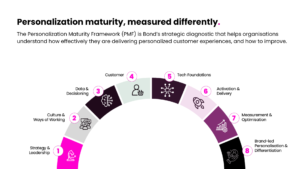
The PMF spans Strategy & Leadership, Data & Decisioning, and Brand-Led Personalization & Differentiation, among others. If you want to understand what it would take to get your brand into an agentic personalization workflow, let us assess where you are and what would get you there. That way, you can focus your investments on the moves with the biggest payoff as AI continues to push the CX landscape forward.
Shoot us a message with the word ‘PMF’ here, and a member of our team will be in touch!




Get insights.
You will receive emails from Bond, including updates and relevant content. You can unsubscribe at any time.