

For Huel, referrals had long been a valuable source of customer acquisition. When participation began to decline, we explored the behaviours and motivations behind customer advocacy, using data science to put organic growth back on track.
From declining channel to core growth driver.
Referrals can be a highly powerful acquisition tool. People trust people more than they trust brands. For a young brand seeking to shake up the way people think about nutrition completely — without massive marketing budgets — what better way to convince someone to try its products than have someone trusted make a recommendation?
And it worked. For a while Huel saw powerful growth through the channel. However, over the last few years the proportion of its customers making referrals had dropped by over half. This in turn led to growing expenditure in other forms of marketing, increasing the cost of acquisition.
For tricky challenges like this, we don’t just look at the numbers or throw out a creative idea and hope it sticks. We take a three-lens approach to really get to the heart of what’s going on — and what to do about it:
- First, we dig into the data to uncover what people are actually doing
- Then, we use consumer psychology to unpack why they’re doing it
- Finally, we layer in a deep understanding of our client’s world, their business model, their commercial pressures, and what’s possible to deliver
It’s only when you look through all three lenses together that you see the full picture and spot solutions that will really move the needle.
Three lenses. One powerful solution.
1. Starting with the data
Our Data Science team took Huel’s referral data and turned it into something truly valuable. After checking the data for quality and completeness, we built a predictive model to work out which customer behaviours were most likely to lead to a referral. From there, every single customer got a “referral likelihood” score — essentially, their odds of telling a friend about Huel.
We then used clustering to group customers not just by referral potential, but also by how valuable they were to Huel’s business. That gave us a golden segment: the VIPeRs — Very Important Potential Referrers. These were the people who loved Huel enough to recommend it and had real commercial value. Better still, we made sure Huel could keep the models updated themselves, so they could always focus on the right customers.
2. Understanding the why
Data can tell you what’s happening, but not always why. That’s where behavioural insight comes in. For a referrer, the big questions were: Will this make me look good? And what if they say no? For the person being referred, trust in the referrer was the deciding factor — and that trust often came down to how genuinely enthusiastic the referrer was about Huel. If we didn’t tackle these human motivations and barriers, even the VIPeRs would be less likely to act.
3. Making it practical
Finally, we needed to ensure every recommendation worked in Huel’s real-world setup — their tech, their budget, their commercial goals. How do we make referring easier for both VIPeRs and their friends? What’s the right reward that feels worth it but still makes business sense? One study in the Journal of Marketing found that when referral programmes rewarded both sides, referral rates jumped by 58%. So getting this part right wasn’t just nice to have, it was essential.
The output of this behavioural triangulation was a collection of ideas designed to deliver significant, incremental impact on referral levels:
- A methodical test programme to find the incentive that delivered the most effective and efficient results from our VIPeRs
- Exclusive benefits for VIPeRs including early access to new and/or free products
- A strong visual identity for the referrals programme to elevate its presence across communications, supported by a content strategy that showcases the unique perks VIPeRs would enjoy
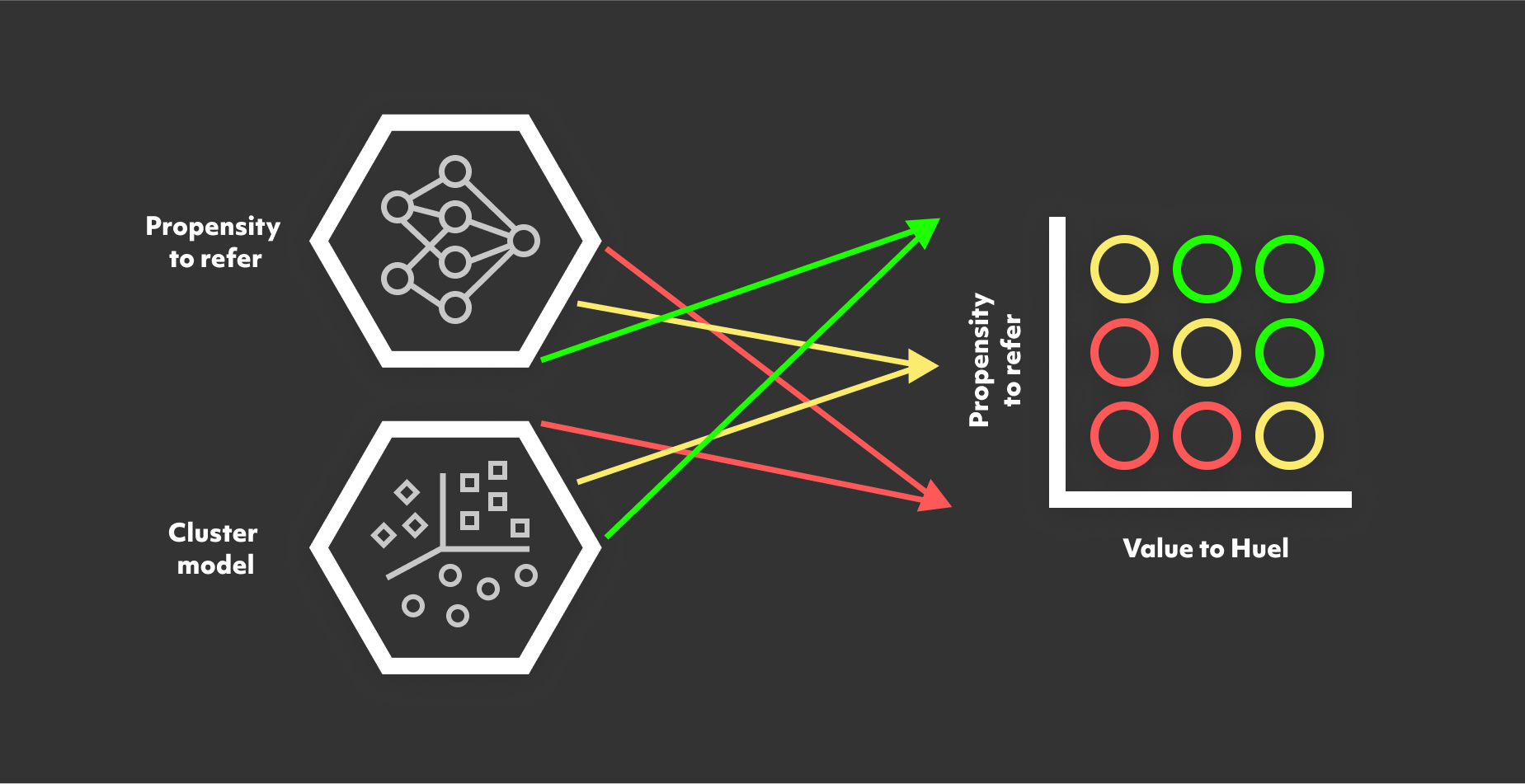
When the right customers are activated, growth follows.
Our work with Huel displays the level of depth, complexity and rigour with which we approach the significant business challenges presented to us by our clients.
By combining predictive modeling with smart segmentation, we created a playbook for personalised, high-impact engagement — identifying the VIPeRs most likely to refer, understanding the human motivations behind their behaviour, and designing a programme built to convert that potential into action.
The recommendations were forecast to deliver a 71% increase in referrals across both the UK and US markets. A result that would restore organic advocacy to its rightful place at the heart of Huel’s acquisition strategy — and dramatically reduce the cost of bringing new customers into the fold.
Don’t just take our word for it. Of our collaboration with Huel, Tash Reynolds, Head of Customer Retention, CRM and Loyalty at Huel, said:
“Working with Armadillo (a Bond company) over the past seven months has been truly transformative for our CRM and Retention team. They have quickly become a seamless extension of our team, boosting our efficiency, creativity and business impact. Their strategic thinking, combined with a deep understanding of our customer and internal challenges, has consistently delivered practical, creative solutions that move our programme forward.”



Get insights.
You will receive emails from Bond, including updates and relevant content. You can unsubscribe at any time.